WARF announces annual grant figures and Innovation Award winners
At a ceremony honoring several of the year’s most outstanding inventions, the Wisconsin Alumni Research Foundation (WARF) announced that it has granted the university $61.9 million for the 2017-18 academic year.
WARF also announced $19 million in grants to the Morgridge Institute for Research. Combined, WARF’s investment in UW–Madison-based research and education is approximately $80.9 million for 2017-18. As in prior years, the annual grant does not include the significant additional value of WARF’s in-kind support in covering patenting, licensing and other expenses.

David Jarrard and Bing Yang won a WARF Innovation Award for their work predicting prostate cancer in tissue biopsies.
The grant was unveiled the same night as two research teams took home WARF Innovation Awards for their outstanding technological achievements: David Jarrard and Bing Yang for their work predicting prostate cancer in tissue biopsies, and Peiman Hematti, John Kink, Eric Schmuck and Amish Raval for developing therapeutic cells for tissue-specific repair.
An independent panel of judges selected the Innovation Award winners from a field of six finalists drawn from approximately 400 invention disclosures submitted to WARF over the past 12 months. The winning inventions each receive an award of $10,000, with the funds going to the UW–Madison inventors named on the breakthroughs.
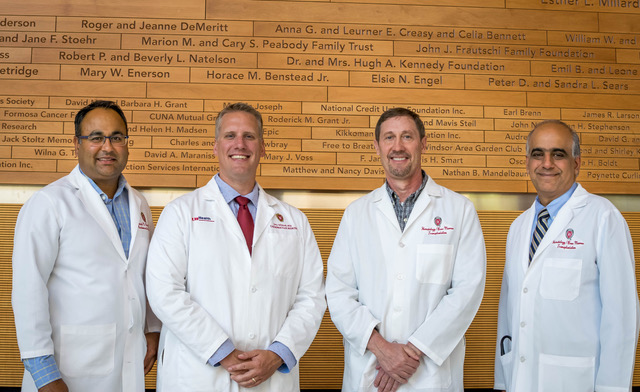
Amish Raval, Eric Schmuck, John Kink and Peiman Hematti (left to right) won a WARF Innovation Award for developing therapeutic cells for tissue-specific repair.
The other Innovation Award finalists included:
Ive Hermans, Joseph Grant, Juan Venegas, Samuel Burt, Philipp Mueller and Somphonh Phivilay for improved catalysts to meet global propene demand.
Michael Arnold, Gerald Brady, Katherine Jinkins and Padma Gopalan for their work developing high quality carbon nanotubes for semiconductor devices.
Mohit Gupta, Brandon Smith, Pratham Desai and Vishal Agarwal for their imaging technique for recognizing hand gestures and other micromotions in 3-D.
Mehdi Kabbage, Damon Smith and Ashish Ranjan for modified soybeans with resistance to stem rot disease and increased drought tolerance.
“WARF invests in the research and extraordinary ideas of UW–Madison,” said WARF Managing Director Erik Iverson. “The annual grant is one way we are helping our campus partners continue to dream big and solve the most pressing problems of our time. Celebrating WARF’s annual grant in tandem with some of our most innovative technologies and their faculty and student inventors draws the clear connection to WARF’s partnership with our university community.”
The Wisconsin Alumni Research Foundation has invested $61.9 million in UW-Madison research for the 2017-18 academic year, and provided $19 million in grants to the Morgridge Institute for Research.